|
Fred Brostoff
In case, you might not have received the Fall, 2024 edition of "The Kit" (the ETHS Alumni Association newsletter - written and edited by our very own Kathy Dalgety Miehls), following are a few articles that you'll find interesting:
ETHS celebrates its 100th anniversary
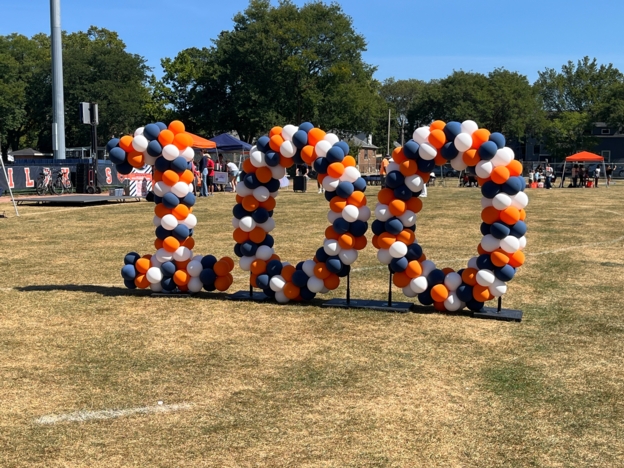
Evanston Township High School is proud to announce the centennial anniversary of its current campus and building, located on 55 acres on Church St. and Dodge Ave. This historic milestone marks 100 years of academic excellence, growth, and recognized commitment to providing a world-class education.
Founded in 1883, ETHS moved to its present location in 1924, heralding a new chapter in the school's history. Since then, ETHS has become a beacon of innovation and equity in education, dedicated to nurturing generations of students and preparing them for success in a rapidly changing world.
To commemorate this significant occasion, ETHS will host a series of events celebrating the school's rich history throughout the 2024-‘25 school year. ETHS alumni, students, faculty, staff, and community members are invited to share in the year’s festivities.
ETHS kicked off its 100th anniversary year with the Centennial Carnivale on September 14 at Lazier Field featuring the ETHS Marching Band, 10+ class reunions, food trucks, free ice cream, music by a DJ, centennial merchandise, and more.
“It is with immense pride and gratitude that we reflect on the hundred years of excellence, growth, and community spirit that have defined ETHS since this campus opened its doors in 1924,” said ETHS Supt. Dr. Marcus Campbell. “The centennial celebration promises to be a time of reflection, reconnection, and recommitment to our mission of providing a student-centered transformative education experience.”
Also as part of the centennial observance was the opening of Alumni Hall in September, a dynamic, future-driven multipurpose learning space. Funded by philanthropic gifts made to the ETHS Foundation, construction for the million-dollar project began in June 2024.
**************************************
From the "Author's Bookshelf" section of The Kit, an article about classmate Preston Cook
Preston Cook, 1964, is a long-time collector of all things “Eagle” having amassed a collection of 40,000 items that he’s donated to the National Eagle Center in Wabash, Minnesota. His current book, Clearing the Air: The Attack of the Giant Eagle, looks at myths about eagles and how these fabulous birds are viewed by particularly American society.
**************************************
How ETHS wound up at Church and Dodge
In 1871, the Illinois legislature approved establishing township high schools anywhere in the state. On April 4, 1882, residents in North and South Evanston, Evanston proper, and Rogers Park approved establishing a township high school: 611 voted yes, 147 no.
But, where to build it was the question. More than three choices were suggested—by the lake, in central Evanston, and elsewhere around town, but a compromise site at the southeast corner of Dempster St. and Benson Ave. (now Elmwood) was chosen because of its access to trains.
The two-story building was erected for $32,500, (including $2,000 to fill in the former cow pasture), and opened August 31, 1883, with Henry L. Boltwood as its first principal, five teachers, and about 150 students.
Boltwood, who could speak 10 languages, came from Princeton, IL. He advocated the curriculum should be classical and college prep, but he also added daily calisthenics, typing, shorthand, astronomy, dramatics, manual training, and encouraged boys’ sports teams. In 1904, he reported that one-third of all students completed the 50 graduation credits and that 45% of all graduates went on to college.
By 1890, the school needed to be enlarged due to ever-increasing enrollment. A south wing was added and enlarged again in 1900.
Boltwood died in January 1906, and Wilfred F. Beardsley, who was hired in 1893 to teach Latin and Greek, and moved up to associate principal in 1900, seemed a likely choice to become principal in February 1906.
Beardsley preferred a classical curriculum, but later added commercial and business courses, girls’ gym, and musical instruction. He also instituted homerooms, summer school, and night school.
Nonetheless, enrollment continued to outgrow the school’s capacity to house students. From 1911 on, annual enrollment grew by 10% and there was little expansion room within the building, including the basement. By 1913, 741 students attended ETHS while the school’s capacity was only for 600.
Two bond issues to expand the current building were held—one in October 1912 was narrowly defeated 112 to 89, and another on November 15, 1913, was defeated by 486 votes, 1,443 to 957.
The latter bond issue went down principally because women, who were permitted to vote in this election—for the first time ever—wanted a school “out of the noisy business district,” noted a local newspaper.
According to the Record Herald: “The women hired carriages and drove their automobiles about the streets of Evanston, bringing voters to the polls, while the men, having cast their ballots, came to Chicago for their regular work.”
While Boltwood wanted to enlarge the building, Beardsley worked to convince Evanston Township residents of the need for a new school on a new site. He hired Dr. Fletcher Dressler of the U.S. Bureau of Education to study the issue.
Noting that Boltwood should have originally purchased enough land to accommodate growth in enrollment, Dressler recommended closing the current building and building a new high school on a newer, larger site.
Other opposing groups also felt a new school was needed to properly serve the community. The school board suggested several new sites: 11-½ acres at Greenwood and Ashland, 15 acres at Lincoln and Ridge, and four additional sites, including land near Calvary Cemetery. But, none won approval with the community.
So, Beardsley and the board divided the issue. They first held a referendum on November 6, 1915, to determine IF a brand new high school should be built. The issue drew 4,129 people and won by a “handy 1,000 votes” the media reported.
This outcome prompted a two-year, legal tug-of-war in the appellate court, the circuit court, and the Illinois Supreme Court.
During this time, Beardsley, who wanted to erect the new high school on the 55 marshy farmland acres at Church St. and Dodge Ave., sought community support wherever he could find it, even with tours of the site. Teachers, who also wanted a new school, joined the public-relations campaign.
A second referendum was held October 11, 1919, to approve the Church-Dodge choice. Of the 9,020 people who voted, 7,950 said yes.
To nail down this decision, Beardsley, who carefully managed district funds, bought the site outright. On December 17, 1921, yet another bond issue was held to pay for building the new school—for $1 million, payable over 20 years, at five-percent interest. With 5,150 votes cast, 4,097 people said yes, 957 said no, and 96 didn’t vote correctly.
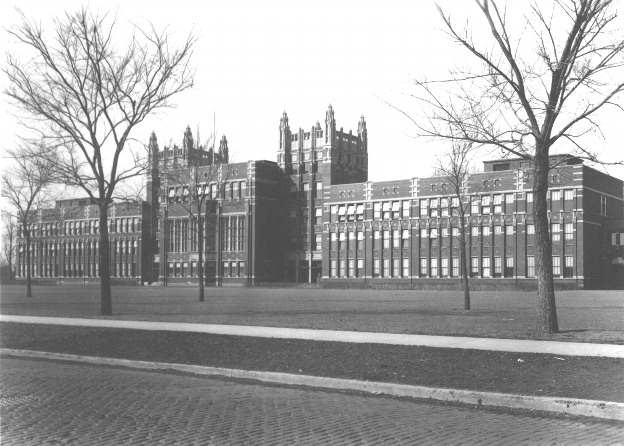
On January 2, 1923, ETHS School Board Chairman Chancellor L. Jenks turned over the first shovelful of dirt for the new school. ETHS opened in summer 1924 with 1,600 students and was capable of housing 4,500. (See below.)
The building was designed by Dwight Perkins with the firm of Perkins, Fellows & Hamilton. His son, Larry, founded Perkins & Will, and designed the rest of the school. The original building resembled an H with the front of the school and the “north” and “east” halls completed. The back two halls, “south” and “west”, were added soon thereafter. Heritage Hall, aka “H Hall,” was in the center “H” of the building,
Although the school was far from complete, accommodations were made. Lockers were still being installed and the heating plant wasn’t yet operating, so coats were worn inside, especially in the winter, and students and staff warmed up by the two fireplaces in the main lobby. Lunch was served in a WW I Quonset hut set up in the rear playfield.
Beardsley, who retired in 1928, envisioned “an expandable plan with the all-important classrooms going in first and plenty of time to add such frills as the auditorium, natatorium, and perhaps even auto shops.”
|





 and fingers crossed!