Message Forum


go to bottom 
  Post Message
  
    Prior Page
 Page  
Next Page      

05/21/25 05:21 PM #2512    


Fred Brostoff

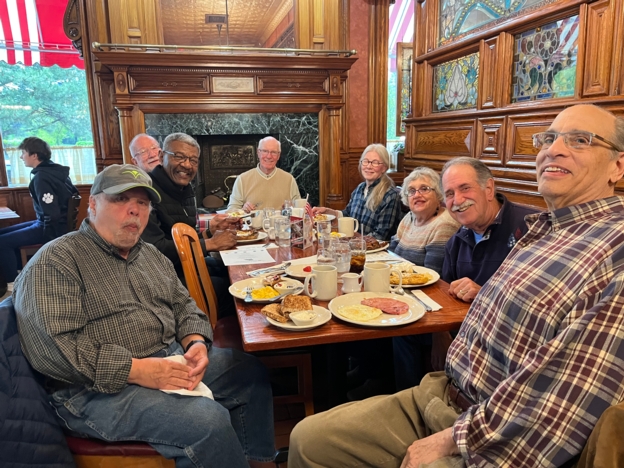
Don Hall arranged for a lunch gasthering of local (Chicago area) ETHS '64 classmates on Wednesday, May 21st, at Walker Brothers Pancake house in Wilmette.

Starting on the left and working around the table...

Ted Lavine, Bob Reece, Pat Furlong, Don Hall, Helga Zirkel Schwarten, Susan Spiegel Pastin, Fred Brostoff, Eric Barinholtz

Thanks to Don for arranging this opportunity to get together and socialize...and have some delicious Walker Brothers food.


05/21/25 06:16 PM #2513    


Sherwin "Jay" Siegall

Don Looks Like CHAIRMAN OF THE BOARD at the head of the table. Wish I could have been there.


05/22/25 10:43 AM #2514    


Robert Lindner

Hmm.

I guess some of us missed this?

Imcluding me. And I live in Wilmette.


05/22/25 02:26 PM #2515    


Susan Spiegel (Pastin)

Robert, join our committee. We have zoom meetings the second Friday of the month at noon and we occasionally arrange local get-togethers. We also are currently discussing whether we want to have a 80th birthday party for our class.


05/22/25 02:30 PM #2516    


Don Hall

Hey Bob L., as a Nichols 7 & 8a graduate of Mrs. Gerlach's class and our classmate (Pat F. and Don H. among others), sorry about that...here's what's going on:

1. Following our 60th Reunion, the '64 Reunion Committee met at Walker Bros in Oct/24 for an "after action" get together.   This was another random gathering of Chicago area committee members wherein I had asked those members to touch base with other Chicago area non-members with little advance notice.

2. Next, we as an "ad hoc committee" decided to keep meeting via Zoom/Google Meets to retain a sense of "continuity" for future reunions as in possibly a birthday reunion (80 years...2026) or at the 5 year point (2029).  We also have strongly encouraged Regional Mini Reunions such as Jay Siegall's gathering in Florida and Mark Goldman's (?) gathering in Arizona.  We hope other regional leaders from our class will do the same in the East, West and other geographically densely populated areas with '64 ETHS grads.  Additionally, everyone will soon see the announcement for the Warren "Billy" Cherry Golf Fundraiser (last Monday in June) that classmate Bob and Patty Reece have successfuly lead for the past 32 years as another source for staying connected while also contributing to a very worthy cause.

3. Finally, we (60th '64 ETHS Reunion Committee) have formed an ad hoc follow-on group (The Reunion Continuty Committee-RCC) to keep the interest and spirit alive.  We meet via Zoom/Google Meet monthly the second Friday at noon to see what the future holds.  Soon, we'll send a message via the ETHS '64 Website (Thank you Fred Brostoff and Art Hallstrom) asking classmates to join our RCC so as to participate in our discussions as to what's next or even possible along the lines of the discussion above.  Important note: we are not the next Reunion Committee, just a means to facilate and seek the next Chairperson & Committee.

So, there you have it...join the RCC when the announcement comes and participate in the discussion of what's next in terms of Reunions, Mini Reunions, worthy opportunities; and, help with nominations for Chairpersons and Committee Members  down the road for the Class of 1964 ETHS as we look to keep reconnecting and revisiting our shared memories.  For the Chicago folks, an occassional Walker Bros non-agenda friendly meeting will randomly occur...don't miss the train...Happy Trails to All. 


05/23/25 10:56 AM #2517    


Robert Lindner

Gosh!

All I wanted was a Belgian pancake with friends. Too big for just one person.

Oakton, Nichols, ETHS, Michigan, Northwestern, Minnesota


05/23/25 01:59 PM #2518    


Robert Lindner

OOPS!

German Pancake (not Belgian).


05/24/25 09:49 AM #2519    


Paula Massey

Walker Bros on Green Bay Rd was always the best for breakfast. Glad they keep going...................


05/31/25 08:05 AM #2520    


Jack Rakove

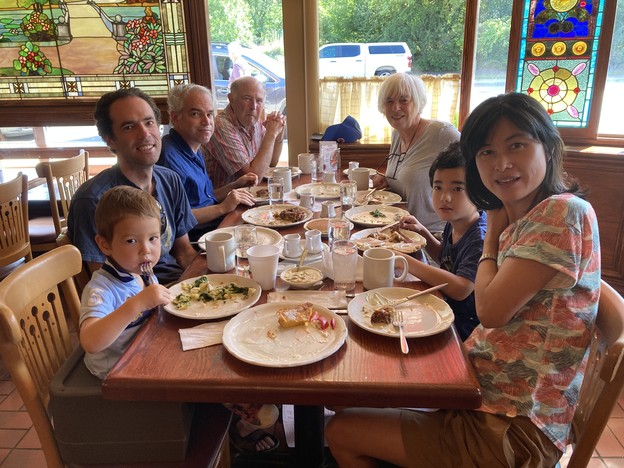
Here's a family photo at Walker Bros. but from four years ago when we all visited my sister Roberta (who lives on Asbury a block from Bob Hamrin's old house). The four in front (my son Dan, Hyesun, Alex, and Elliot) are bound for Tashkent two months from now, which will make family visits a tad more difficult, but we are planning one for October. I was just at WB six weeks ago but during a sad trip occaioned by a memorial service for a Gale School friend of mine (Gale is the school you see from the Howard El platform). Under the circumstances, the bans on eating chometz during Passover were mysteriously lifted, so there is evidence of two apple pancakes on the table. That is also why I stopped at Johnny's Beef in Elmwood Park for an Italian beef sandwich on the way to O'Hare. Back in the day, I used to eat those at the Villa Girgenti on Paulina, and I just learned that Girgenti is the Sicilian version of the town of Agrigento in sw Sicily.


06/01/25 01:12 PM #2521    


Robert Lindner

The mention of Tashkent reminds me...

Tashkent is the capitol of Uzbekistan amd

my parents were in Namagan in Uzbekistan

during WW-2, where they had gone from Warsaw

Poland. They were there in 1946, when I was

conceived. I was then carried, in utero, back to

Warsaw and then to Salzburg to be born. 


06/01/25 01:13 PM #2522    


Robert Lindner

Namangan.


06/01/25 03:51 PM #2523    


Jack Rakove

Bob: I'd be curious to know, and I think our classmates would be interested, too, when and how your parents left Warsaw and also how they wound up in Uzbekistan--which was then a Soviet republic, of course. Almost every story of this kind that one hears is incredible in its own way.


06/02/25 11:49 AM #2524    


Robert Lindner

OK Jack, 

You asked for it.

Here is part 1  Rose is my mom and Paul is my dad.

Warsaw, September, 1939


The bombing began on September first,

And with Luftwaffe, blitzkrieg, the world was cursed.

In Warsaw, Helen’s city, as the bombs fell,

She played on her violin while all hell

Broke loose. “Just get away from the windows!”

A voice shouted. Her sister-in-law Rose.

But Helen was defiant and angry.

“To hell with the bombs, they’re not making me

Run away.” She yelled, as the violin

Sang under her flying bow. It flashed in

The fire of the antiaircraft weapons

And the glowing search lights that gleamed like suns.

She played Bach’s Chaconne, her favorite piece.

She played, as if she could make the bombing cease.

Rose watched her and then yelled, “What’s the worst thing

That can happen? Right! You might break a string.”

And laughed. “Laughter, it’s what you have to do,

When the world is coming down around you.”

Rose would later say, long after this first

Day of the war, which would not be the worst.

The worst was yet to come. This was day one.

And the second world war had just begun.

The world changed. Just three months ago in June,

Rose got married and Helen played a tune

That was quite different. A little song

By Mendelssohn. Now her bow flies along

The strings as the Luftwaffe flies overhead.

Before day’s end many would be dead.

But this was not the prelude anymore.

This was the first chapter of the world war.

In which many millions would be displaced

Or die. Not knowing what troubles she faced,

Rose threw herself into a soft arm chair

And listened to Helen play, as the air

Outside the large windows filled with fire

And smoke. But Rose would not sit and admire

This scene for long because their husband’s calls

Took them to safety in a shelter’s walls.

There Rose was worried and Helen was vexed.

But neither one knew what would happen next.

They all sat there in the shelter that night.

Then went to check if others were alright.

It would be the last time they were all there.

The next day bombers were back in the air.

Helen’s husband Matthew, a doctor was

Called into service the next day because

There were so many casualties to treat.

He would be captured after the defeat.

After the brief siege of Warsaw ended

And the city couldn’t be defended

Any longer. The army had retreated.

And Poland’s division was completed.

Then the Soviet armies would march in,

When division by Hitler and Stalin

Of Poland was set later with a treaty.

There on September first they would all be

Huddling in the bomb shelter waiting for

The bombs to stop. And though there would be more

Bombing, it stopped. They looked at each other.

There was Rose and Helen and their brother.

And the husbands and their parents, Toly

And Joseph. Paul went to get some Stoli.

“You can’t stay sober at a time like this.”

He said, downed some and gave wife Rose a kiss.

Helen laughed and picked up the violin.

She plucked the strings, tucked it under her chin.

“What’s the worst thing that could happen?” She said.

“We could be dead drunk or end up dead, dead.”

And she played a Russian tune, a folk song.

She didn’t know that it wouldn’t be long

Before they would all go to Russia to

Escape from the war, but this day they’d do

What they had to, to stay out of harm’s way,

Drink vodka and sing and Helen would play.

It was just the first day of the long, long

Tales of a world war. “What else could go wrong?

What’s the worst thing?” They would laugh, drink and sing.

Well… Toly, she’d worry, that was her thing.

She lived through the first world war, so she knew

What else could go wrong, what a war could do.

But she could not imagine the worst thing

That would happen. This was the beginning

And there was nothing they could do, but hope

For the best and expect the worst and cope

With the struggles they would have to endure.

The disease had come. They must find the cure.

The disease was war. It was the first day.

As the bombs dropped, she began to pray.

But the bombs had stopped, they were in the calm,

But she knew the storm would return with bomb

After bomb. The war had begun. “Day one,”

She thought, “Much more to come before it’s done.”

Still, the family was there together.

Though storms were coming perhaps they’d weather

Them. “With God’s help,” she thought. That was Toly.

Anatolia. Queen of all that’s holy.

A Russian name from Tolstoy’s War and Peace.

A place once part of Alexander’s Greece.

“Toly” for Anatolia and Tolstoy.

Rose and Mathew’s mother and Joseph’s joy.

She enjoyed the singing, but not the Stoli.

But she took a little wine. That was Toly.

The wine was holy. It was Sabbath night.

And she had brought the candles down to light.

Silently she said the Sabbath prayer.

First “Boruch,” ending with “l’had lik ner.”

“Shell Shabas!” They all yelled and raised their hands.

They did not know they’d be wearing armbands

With the star of David in days to come.

But on this night, Joseph began to hum

The prayers and Helen played behind him

And the mood became sober, but not grim.

Though they were in the cellar, there was light

And candles, food and wine for Sabbath night.

They sat on the extra chairs that were for

Parties when there was a dinner for more

People, for the extended family.

They’d have to wait for tomorrow to see

How their loved ones had faired. It did not pay

To worry, nothing could be done this day.

Friday, September 1, passing into

Memory. Into Saturday, a new

Day, day two of the story of this war

That would go on for two thousand days more.

But tonight Helen would play the hora

And “Hora Staccato” which was more a

Gypsy tune and flashy violin show

Piece and everyone clapped along so though

There was great madness in the world outside

Their shelter tonight they would sing and hide

Their worries and fears, as September One

Went into history. War has begun.

More than two thousand days to go

Before it ends. So this continues, though

Not as long as War and Peace, with Toly,

But not with Tolstoy, as the family

With Helen, Mathew, Joseph, Paul and Rose

And they must go on as long as life goes

On. There shall be horror, struggle, and more.

And amore, but you will have to wait for

Sunrise on day two, to see what’s in store

For the family, including some more

Of many other family members

Whose names and stories wait for September’s

Days to pass and become October’s days.

It’s 1939 and in the haze

Of war there shall be an escape or two,

Some hiding, some harrowing travels through

Borders and on trains that are attacked by

Dive bombers. But today ends, the sky

Is quiet and the family must sleep

When they can. Though tomorrow they may weep,

Today they sang, prayed and played through their fears.

And next? There’s this war that will take 6 years.


06/02/25 02:07 PM #2525    


Susan Spiegel (Pastin)

WOW!  That was moving!  it should be widely published!  It gives me no respect for what our parents' generation had to endure, as we face our own historic time of troubles.


06/02/25 02:53 PM #2526    


Rosemary Burg (Heilemann)

Thank you for sharing your family's story in this way, Robert.  


06/03/25 08:15 AM #2527    


Frances O'Connell

Robert, thank you for sharing your very moving family story


06/03/25 02:37 PM #2528    


Robert Lindner

Since I have been encouraged, here's more

1939 Continued

A call to arms went out September four.

And all young men were called to go to war,

Join the Polish armies, as they withdrew

After the Germans began to break through

Their lines and Czestochowa fell, the first

Of many cities that would follow, be cursed

With Nazi rule. But this was still to come.

But on September fourth there was still some

Hope that the English and French would begin

A western offensive since they were in

A pact with Poland and the Poles had heard

That they declared war on September third.


The call on the fourth was for all young men

To “regroup” with the Polish army and then

With a larger force hold the Germans back

And wait for France and England to attack.

So Paul and Rose’s brother had to go,

Though what would happen next they couldn’t know.

Since Rose’s younger brother, named Soly

Was eighteen, Joseph was told by Toly

To go too. So they followed the order,

Not knowing they’d be across the border

When the Russians and Germans divided

Poland, something that had been decided

By Hitler and Stalin before the war

Began. So that day on September 4,

The men were called to go out to the east,

But since the German bombing had not ceased

It was a dangerous journey, and they

Would be on the Russian side where they’d stay.

The Russians came on September 17

And created a new border between

The part of Poland taken by Stalin

And the part the Germans still had to win.

But by that September’s end Warsaw fell,

And with that came the Nazi kind of hell.

What followed? Do not ask for whom the bell

Will toll. 6 years were still to come to tell

This story. But now it’s still September,

And there’s more tales for me to remember.

So the women stayed behind on their own,

But it turned out they were not alone.

Some of their cousins joined the underground

And it was with their help that Helen found

Where Matthew had been taken and was

Being held. Later he escaped because

They came with an ambulance that they got.

And said there was an outbreak. There was not,

But his guards believed them. Outbreaks of dread

Disease, that the guards feared could  too soon spread

To them and their fear, Rose and Helen knew

Would be greater than their need to hold onto

One doctor, so they let Matthew go free,

But later when he and Helen would flee

From the city things would not go as well.

But there’s October’s tale for me to tell

About and months and years to follow that.

We’re just into this long story, still at

The beginning. The next part is about

How the women followed the men, got out

Of Warsaw and crossed to the Russian side

Of the border created to divide

Poland between Russian and German rule.

They knew that the Germans would be more cruel,

And though the Russians would not be that good,

They were better off with them and that would

Prove to be the right choice. So the women

Escaped from Warsaw, with help, once again

From cousins who were in the underground.

They fled to the hills in horse-carts, then found

Themselves near the new border guarded by

Germans west and Russians east, but they’d try

To cross. Toly, Dora, and Rose and their

Cousins all stopped, found a hut somewhere

Near the new border to wait in because

Mother Toly couldn’t walk since she was

Injured and afraid so they spent the night

In the abandoned hut. It was the right

Choice, but they did not know that till morning.

Rose dreamed, and her nightmare was a warning

That night, as they slept in the fitful sleep

of exhaustion. Rose dreamed that in the deep

Woods there was the house from the story of

Hansel and Gretel playing out above

Her, as she lay there on a bed of straw,

They were now far from her home in Warsaw.

German soldiers were dressed as Gretel and

Had blond wigs with pigtails and a headband

That was pink. They were pushing witches in

The fire. Rose thought she could smell burning skin.

Then she awoke and it was just her cousin

Tending a fire to keep them warm in

The little hut near the border they would

Try to get across the next day. How could

She know that her dream was a prophesy

Of a terror that was to come. But she

Knew the Nazis had shown their evil face

That would turn them into a master race

Of monsters that dehumanize to serve

Themselves the bounty they think they deserve.

Perhaps Rose knew because she knew the flaws

Of man. She received a Master of Laws

And was a law clerk for Lemkin, the same

Man, whose writings about war crimes became

Origins of the crime of genocide.

But back to the story. They’re still inside

The hut as sun rises over the plain.

And the dream that Rose would later explain

Is gone where all dreams go, and they must go,

Cross the border in the morning’s first glow.

Will there be Germans guarding the new line?

No. There were Russians, but it all went fine.

The Russians even helped Toly that day.

Then all were together there and would stay

In the part of Poland that was controlled

By Russia. They would work there and would hold

Onto what they could hold onto until

The war would progress, as we know it will.

Then the Germans will push into the east.

And evils, fears and horrors were increased.


06/04/25 07:05 PM #2529    


Rosemary Burg (Heilemann)

This is so gripping, Robert.  I understand that you have these stories deep in your heart, but had you written this all out in the past, or are you composing it now?  This epic poem reads very polished and spontaneous at the same time.  It makes me sad and wishing I didn't have to hear more, and also makes me want to hear everything.  Please go on.  


06/05/25 02:28 PM #2530    


Paula Massey

thank you, thank you Robert for sharing.....................


06/10/25 03:48 PM #2531    


Robert Lindner

A Ticket to Samara
an impossible day to forget (In the voice of my mother -Rose)
 
There were many days during WW-II that were unforgettable. This special day was when our family found each other in central Russia. It was August 24, 1941. At the time, German armies were attacking the Soviet Union, an attack that began on June 22, 1941.
We were at the train terminal in Kuybyshev, a city renamed in 1935 after a “hero of the Russian Revolution” (Historically and currently, the city was and is again called Samara). We were hoping to catch the Trans-Siberian train to Chelyabinsk, where my brother, Solomon, thought my parents and my sister, Dora, and her husband, Martin, had been sent. 
It was hard to trust the Soviet government, but Solomon had heard they might be there from family friends, whose families were also trapped by a Soviet trick and sent to Siberia. The trick was offering Polish refugees the choice of taking Soviet citizenship or returning to Warsaw in the summer of 1940. At that time, the USSR and Germany had divided Poland and were at peace with each other with a truce called the Molotov–Ribbentrop Pact. We had escaped from Warsaw following the German attack of September, 1939 and in 1940 we were living in Lvov, a Polish city which was on the Soviet side of the divided Poland.
My husband, Pavel and I had good jobs in Lvov and when the Soviets approached us, we decided to keep our jobs and take Soviet citizenship papers. Because Solomon was studying engineering in Saratov, Russia, he also chose to become a Soviet citizen. My parents and my sister and her husband believed the Russian lie and chose to return to their life in Warsaw. But the Soviets had no intention of sending anyone back to Warsaw, and those who chose that option were shipped off to Siberian work camps.
In June, 1941, when the Germans attacked the Soviets, we had to leave Lvov to escape the onslaught. First, we went to Saratov to try to meet Solomon, only to find he had gone to Kuybyshev. Some of his university friends passed along his message that he was planning to go east to find our family. Solomon had heard that because of the German attack on the Soviets, the Soviets had made make a pact with the Polish government in exile and Poles were being released from Siberian work camps and he was planning to go east try to find our parents and sister.  
When we went to meet him in Kuybyshev it was already August, 1941. After a few days of planning, we decided we would all go to Chelyabinsk. We were hours early for the train.  And as we waited in the train terminal our plans suddenly changed. We happened to see someone there we knew. It was a woman named Irene, a friend from both Warsaw and Lvov. Irene was one of the deportees to Siberia. Breathless with excitement, I asked Irene if she had seen our family members.
Irene said, “Of course, everyone remembers your sister Dora. She caused quite a stir at our camp when she made paper costumes for our theatre. Dora’s costumes were meant for entertainment, but the camp director thought they were an insult to the government. We all laughed a lot, but poor Dora got sent to a detention room as punishment.” After a moment, Irene added, “But she was fine when I saw her last time.”
“Where, when?” Solomon and I asked at the same time.
Irene said, “When we were leaving the camp, I saw her go by. But she was not on the train that we were on.” There were many more questions for Irene, who told them the work camp was past Chelyabinsk, near to Yekaterinburg. But where had they gone? She didn’t know.
While we were all catching our breath, Irene, suddenly, pointed at a man and said “Ask Stephan.” “Stephan,” she called to him. The man turned around and Irene led Solomon to him. “Stephan, dear, this young man is looking for Dora. You know who.”
“Yes, of course” said Stephan. “She and her family took the train that left before ours. You can look here, but I think it went south. I would guess that it went to Ufa. We passed through there.”
“Could they have been going to Saratov?” Solomon asked.
“More likely Orenburg. Of course, I can’t be sure. No. I am wrong. Because Martin knows where his wife is.” Stephan laughed and pointed, as Dora’s husband, Martin suddenly appeared.
Solomon laughed too and called to me. “Rose, Rose, Rose! They are here! Your Solomon knows where to go.”
Martin heard him shouting and steered Dora around to see.
“How about this?” Dora shouted.
“So they are found!” Pavel yelled.
Then my parents, Toba and Joseph turned around. Soon, we were all reunited with kiss after kiss. 
Later, we were all together in the apartment where Pavel, Solomon and I had been staying. The apartment was crowded with the three of us. Now there were seven.
It was August 24, 1941, and with the family together, the next part of the story can begin.

06/10/25 09:17 PM #2532    


Rosanne Bass (Keynan)

I loved reading your mother's account, Robert. Oh, what your family lived through; it easily could have gone another way. How fortunate you are to have a written narrative. My grandparents, who were the immigrant generation on both sides of my family, never volunteered information. And I didn't think to ask until it was too late.


06/11/25 12:22 PM #2533    


Susan Chausow (Southam)

Robert I am very moved by these pieces of family history. And they resonate today, oh boy do they resonate as I watch the news, especially this last week's images of chaos and fear. Roseanne, I also waited too long to get my grandparents' memories. I know too little and I so wish I knew more. 


06/12/25 01:20 AM #2534    


Susan Spiegel (Pastin)

I too thought of the immigrants in Chicago who went to what they thought would be regular check-ins but instead got detained.  I am so glad though your family found each other at the train station! That is quite a story. Keep going…


06/12/25 01:20 AM #2535    


Susan Spiegel (Pastin)

I too thought of the immigrants in Chicago who went to what they thought would be regular check-ins but instead got detained.  I am so glad though your family found each other at the train station! That is quite a story. Keep going…


06/13/25 11:29 AM #2536    


Fred Brostoff

If you haven't seen this article in the latest "The Kit" ETHS alumni news letter, here's a copy of the article about Kathy Miehls' retirement.


go to top 
  Post Message
  
    Prior Page
 Page  
Next Page